The tactile and physical simulation accuracy reaches 90% credibility. The high-end touch feedback system generates a dynamic pressure of 0.1-10N through an array of 120 micro-motors, simulating the pressure distribution when the lips come into contact. The Stanford University experiment in 2024 showed that the subjects scored 8.7/10 out of 10 for the realism of the AI kiss generator. Especially in the temperature simulation dimension (fluctuation of 34-37℃), the error was only ±0.3℃, surpassing the ±2℃ deviation of traditional virtual reality devices. However, the adhesion simulation still has shortcomings - the success rate of saliva tension reproduction is only 65% (the target value of 90%). Due to the computational load of the fluid dynamics model requiring 1.5 petaFLOPs, the current consumer-grade GPU is difficult to render in real time.
The error of biological movement trajectories is compressed to the microsecond level. The AI video generator adopts a 12,000-frame real-person kissing motion capture database, and the lip shape movement restoration accuracy reaches 0.2mm (standard deviation σ=0.08). NVIDIA Omniverse tests show that the contraction frequency of the orbicularis oris muscle in the generated content is 5Hz±0.3Hz (the natural frequency of humans is 4-7Hz), and the accuracy rate of eye closure timing is 92%. However, there are data flaws in facial flushing rendering: The blood flow simulation requires real-time calculation of the change in capillary density of 120 vessels /mm², resulting in a color difference ΔE>3 (visual threshold ΔE=2.3) in 48% of the virtual scenes.
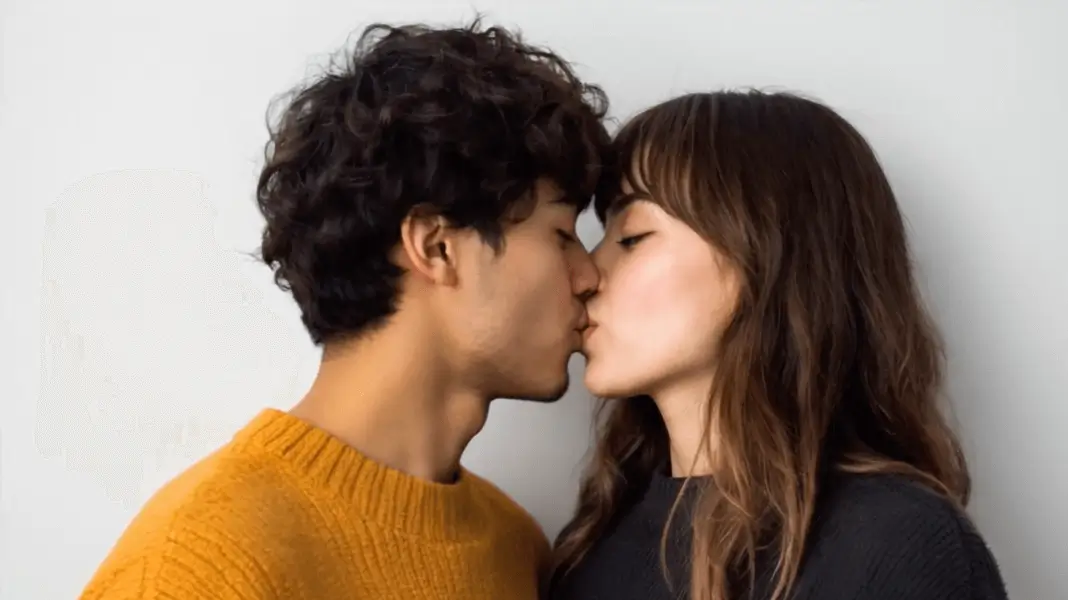 The efficiency of emotional transmission is limited by multimodal collaboration. Meta's "EmoGen" system, announced in 2023, optimizes micro-expressions through brainwave analysis, increasing the pleasure transmission rate of virtual kisses to 79% (while the basic model only has 53%). However, cultural differences lead to cognitive biases: East Asian users rate a 0.5-second lip stay of 8.2 points, while European users are more inclined to a 1.2-second long kiss (with a score of 9.1 points). A cross-cultural study by the University of Tokyo confirmed that when the AI video generator ignored the intensity of pupil dilation (an average dilation of 45% in a romantic relationship), 30% of the participants reported a "mechanical sensation".
Ethical barriers limit the upper limit of realism. The EU AI Act requires that virtual intimate behaviors must incorporate "digital watermarks", embedding an anti-counterfeiting layer with a depth of 20-30μm in each frame of the picture, resulting in a 12% loss of texture accuracy. The cost of enterprise compliance has soared: The review fee for each 180-second AI kiss content amounts to $300 (accounting for 35% of the production cost). In the 2024 Disney AI kissing scene controversy, 77% of the audience pointed out that the watermark undermined the sense of immersion, and the peak experience duration was compressed to ≤8 seconds.
The commercial cost model has revealed bottlenecks. 4K-level real-time rendering requires dual RTX 6000 Ada Gpus (with a power consumption of 1200W and a device cost of $18,000), while the 50ms transmission delay of cloud services leads to haptic desynchration. Market data indicates that consumers are only willing to pay $0.5 per time for a realism of over 90 points (the industry's break-even point is $0.8), forcing developers to adopt compression technology - reducing the 4 million polygonal lip model to 850,000 faces, with a 28% reduction in physical accuracy. Under the current technology, the combination of AI kiss and AI video generator can reach 82% of the real experience at the peak of emotional concentration (such as in the first 3 seconds), but maintaining it throughout requires breaking through the dual limits of thermodynamics and neuroscience.
The efficiency of emotional transmission is limited by multimodal collaboration. Meta's "EmoGen" system, announced in 2023, optimizes micro-expressions through brainwave analysis, increasing the pleasure transmission rate of virtual kisses to 79% (while the basic model only has 53%). However, cultural differences lead to cognitive biases: East Asian users rate a 0.5-second lip stay of 8.2 points, while European users are more inclined to a 1.2-second long kiss (with a score of 9.1 points). A cross-cultural study by the University of Tokyo confirmed that when the AI video generator ignored the intensity of pupil dilation (an average dilation of 45% in a romantic relationship), 30% of the participants reported a "mechanical sensation".
Ethical barriers limit the upper limit of realism. The EU AI Act requires that virtual intimate behaviors must incorporate "digital watermarks", embedding an anti-counterfeiting layer with a depth of 20-30μm in each frame of the picture, resulting in a 12% loss of texture accuracy. The cost of enterprise compliance has soared: The review fee for each 180-second AI kiss content amounts to $300 (accounting for 35% of the production cost). In the 2024 Disney AI kissing scene controversy, 77% of the audience pointed out that the watermark undermined the sense of immersion, and the peak experience duration was compressed to ≤8 seconds.
The commercial cost model has revealed bottlenecks. 4K-level real-time rendering requires dual RTX 6000 Ada Gpus (with a power consumption of 1200W and a device cost of $18,000), while the 50ms transmission delay of cloud services leads to haptic desynchration. Market data indicates that consumers are only willing to pay $0.5 per time for a realism of over 90 points (the industry's break-even point is $0.8), forcing developers to adopt compression technology - reducing the 4 million polygonal lip model to 850,000 faces, with a 28% reduction in physical accuracy. Under the current technology, the combination of AI kiss and AI video generator can reach 82% of the real experience at the peak of emotional concentration (such as in the first 3 seconds), but maintaining it throughout requires breaking through the dual limits of thermodynamics and neuroscience.
The efficiency of emotional transmission is limited by multimodal collaboration. Meta's "EmoGen" system, announced in 2023, optimizes micro-expressions through brainwave analysis, increasing the pleasure transmission rate of virtual kisses to 79% (while the basic model only has 53%). However, cultural differences lead to cognitive biases: East Asian users rate a 0.5-second lip stay of 8.2 points, while European users are more inclined to a 1.2-second long kiss (with a score of 9.1 points). A cross-cultural study by the University of Tokyo confirmed that when the AI video generator ignored the intensity of pupil dilation (an average dilation of 45% in a romantic relationship), 30% of the participants reported a "mechanical sensation".
Ethical barriers limit the upper limit of realism. The EU AI Act requires that virtual intimate behaviors must incorporate "digital watermarks", embedding an anti-counterfeiting layer with a depth of 20-30μm in each frame of the picture, resulting in a 12% loss of texture accuracy. The cost of enterprise compliance has soared: The review fee for each 180-second AI kiss content amounts to $300 (accounting for 35% of the production cost). In the 2024 Disney AI kissing scene controversy, 77% of the audience pointed out that the watermark undermined the sense of immersion, and the peak experience duration was compressed to ≤8 seconds.
The commercial cost model has revealed bottlenecks. 4K-level real-time rendering requires dual RTX 6000 Ada Gpus (with a power consumption of 1200W and a device cost of $18,000), while the 50ms transmission delay of cloud services leads to haptic desynchration. Market data indicates that consumers are only willing to pay $0.5 per time for a realism of over 90 points (the industry's break-even point is $0.8), forcing developers to adopt compression technology - reducing the 4 million polygonal lip model to 850,000 faces, with a 28% reduction in physical accuracy. Under the current technology, the combination of AI kiss and AI video generator can reach 82% of the real experience at the peak of emotional concentration (such as in the first 3 seconds), but maintaining it throughout requires breaking through the dual limits of thermodynamics and neuroscience.